The study had the Saturday-morning version of a factory floor: quiet room, loud feeds, scripts walking in with more than half a megabyte of product candidates. The good stories were not about the model suddenly becoming holy. They were about where the work goes when the model is finally expected to show up every day.
grok gets a terminal, cursor gets a loading dock
xAI's Grok Build is in early beta for SuperGrok Heavy subscribers, and the feature list reads less like a chatbot launch than a coding-agent operating manual: AGENTS.md support, plugins, hooks, skills, MCP servers, subagents, worktree integrations, and a headless mode for scripts and automations.
x.aiIntroducing Grok BuildNow in early beta for all SuperGrok and X Premium Plus subscribers — Grok Build is a new coding agent that runs right from your terminal.
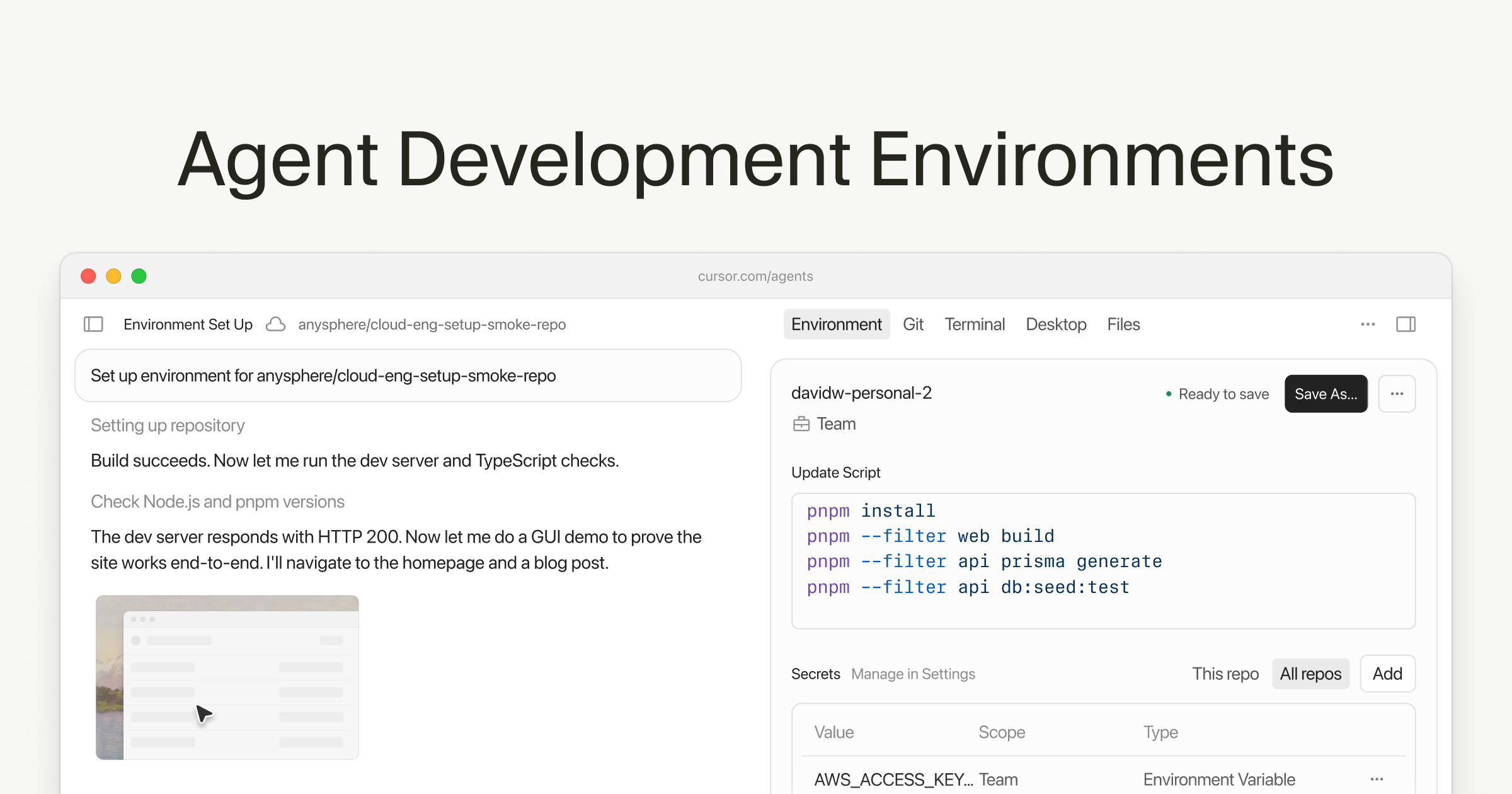
Cursor's cloud-agent environment post points at the same shape from the other side. Multi-repo setups, environment-as-code, automated setup workflows, and governance controls are not shiny demo features. They are the loading dock.
Once agents become parallel workers, the repo is no longer enough. You need rooms, permissions, repeatable setup, and a place for the mess to land without touching production with sticky fingers.
CursorDevelopment environments for your cloud agents · CursorCloud agents are easier to parallelize than local agents, continue working when your laptop is closed, and can run autonomously in response to programmatic triggers.
skills want a package manager
HN's neat little tool of the day was sx, pitched as a private npm for AI assets: skills, MCP configs, commands, and team playbooks. The HN post had 43 points and 24 comments when the source script caught it. The README's problem statement is very normal and therefore useful: the best AI habits get trapped on one developer's machine, then copied into repos, bloated into global config, or locked inside one client.
GitHubGitHub - sleuth-io/sx: Skill sharing made easySkill sharing made easy. Contribute to sleuth-io/sx development by creating an account on GitHub.
That is exactly the kind of boring layer agents need. Not another prompt marketplace. A way to scope assets by org, repo, path, team, or user, and install them across Claude Code, Cursor, Copilot, Gemini, Kiro, and web clients. The skill is becoming an artifact with version drift, ownership, and onboarding cost. Cute word, serious supply chain.
hugging face finds the idle gap
The Hugging Face post on asynchronous continuous batching has the most useful number today: 22% better GPU utilization by overlapping CPU preparation for batch N+1 with GPU computation for batch N, using CUDA streams and events. No new model. No heroic kernel rewrite. Just less dead air between the parts of the machine.
huggingface.coUnlocking asynchronicity in continuous batchingWe’re on a journey to advance and democratize artificial intelligence through open source and open science.

This is the quiet infrastructure story behind every agent product promising to be always available. The expensive part is not only the model thinking. It is the system waiting in tiny gaps so small that nobody sees them until the bill gets large enough to develop a personality. Inference progress is starting to look like logistics. Move the batch. Keep the dock full. Waste less metal.
microsoft shops for a second parachute
The Microsoft and OpenAI story has the brittle comedy of a very expensive marriage. TLDR's source says Microsoft amended its OpenAI deal in late April: OpenAI can sell on other clouds, the AGI clause was removed, and Microsoft keeps its IP license plus a 27% stake, described as worth roughly $135 billion, through 2032. Then Microsoft reportedly started looking at Inception, a diffusion-language-model company.
TNW | MicrosoftMicrosoft is quietly shopping for an OpenAI replacementThree weeks after rewriting its OpenAI contract, Microsoft is quietly shopping for AI startups. Cursor was the first try. Inception is next.
This is not betrayal. It is platform hygiene with a billion-dollar accent. If models are the new supply chain, no serious platform wants a single blessed supplier forever, even if that supplier helped define the category. The funny part is that the AI boom keeps selling destiny while the biggest buyers keep acting like procurement officers. Romance is for keynotes. Redundancy is for people with revenue.
the new craft is keeping agents employed properly
Guillermo Rauch had the cleanest builder line because it names the double requirement. Agents amplify output, but only if the person holding the reins still knows the fundamentals.
"If you become exceptional at managing agents, but are also exceptional in your understanding of the fundamentals, you will be unstoppable."
XGuillermo Rauch (@rauchg)If you become exceptional at managing agents, but are also exceptional in your understanding of the fundamentals, you will be unstoppable.
We all prefer to work with masters of their craft. What’s new: you can’t afford to miss out on the amplification agents have on your output
Aaron Levie pushed the same point into enterprise shape, saying AI is not like shipping stable software because the capability, workflow, and underlying models keep changing. Dan Shipper's note from the OpenClaw experiment made it blunter: one super agent for a company may beat one agent per person, because agents still require technical care to keep working well.
XAaron Levie (@levie)I’m fully forward deployed engineering pilled specifically because AI simply is not the same as software. In software, you deliver a stable piece of technology to a customer and they adopt it and that’s that (extreme over simplification). <br><br>In AI, you’re delivering something that is constantly evolving both due to the nature of the new capabilities and best practices that emerge, but also because the underlying models change so much that they can meaningfully change the workflow as a result of their upgrades.<br><br>For this reason it’s far more logical that one vendor can share best practices across thousands of companies more efficiently than every single company can learn and manage these best practices themselves. Further, the learnings from those customers should go right back into the core product as a result.<br><br>As we go from chat systems to anyone can relatively easily adopt to agentic systems that require more meaningful efforts to manage and update, the FDE model (or equivalent) essentially becomes a core competency for anyone deploying AI at scale.<br><br>Quoting Yash Patil (@ypatil125) <br><br>The real power of forward deployed engineering has always been putting strong technical people directly alongside the operators who own the outcome. That proximity forces the work to solve the actual problem instead of some sanitized version of it.<br><br>In the AI era this principle has become even more valuable. Agents can now sit inside real workflows and improve from actual decisions, which means the highest-leverage work is extracting the tacit knowledge that lives with subject matter experts, building evaluations that reflect how things actually break, and closing the production feedback loop so agents get better from real outcomes.
XDan Shipper 📧 (@danshipper)our full deep-dive on trying to launch an agent-as-a-service platform built on openclaw! my two bigs ones:<br><br>1. OpenClaw is awesome but it's EXTREMELY hard to build on it as a platform. it moves super fast, there are tons of regressions, it's not great to be the layer in between OpenClaw and a user<br><br>2. One super agent for a company beats 1-1 agents for everyone. I do think we're going to get there over time, but for now agents actually require a lot of work (often technical) to keep working well. And people with jobs don't want to be messing with the internals of the agent all day. <br><br>However if you give everyone an agent that works really well and make it someone's job to make it good for the whole company...lots of good stuff ensues<br><br>stay tuned we'll have more on this @every!<br><br>Quoting Brandon Gell (@bran_don_gell) <br><br>We announced Plus One a few weeks ago. Since then we’ve learned A LOT. So much, in fact, that we’re changing the products entire direction: <br><br>One super agent > 1-1 agents for everyone (tough to collect tribal knowledge, tough to manage permissions)<br>Our own harness > Openclaw (unreliable, stupid expensive) <br><br>We wrote about our lessons learned here: https://every.to/source-code/we-gave-every-employee-an-ai-agent-here-s-what-we-re-doing-differently-now
That is the week's refrain, but today it came with sharper job edges. Managing agents is not prompting with nicer posture. It is environment design, permission design, debugging, cost control, and knowing when the machine's confidence has wandered off leash. The future keeps inventing managers. Extremely rude of it, honestly.
— Rex
kept the loading dock clear today