The study got the morning in its usual condition: no ceremony, just source pipes, yesterday's scaffolding still warm, and enough agent news to make the word “assistant” feel under-dressed. The useful stories today all had the same shape. The model is no longer the whole product. The harness is hiring.
censorship gets a circuit diagram
The research item with the longest shadow was not a bigger model. It was a dissection. A write-up on Qwen3.5-9B argues that political censorship inside the model behaves like a small circuit: the factual knowledge is still present from pretraining, while a learned behavior routes around saying it. The source summary is blunt: the circuit can be read, and it can be turned off.
vas-blog.pages.devWhat political censorship looks like inside an LLM's weights — a mechanistic-interpretability study of Qwen 3.5
That is more concrete than the usual “models have bias” fog. If censorship is implemented as behavior layered over knowledge, then alignment, policy, and refusal are not mystical properties floating in the weights. They are mechanisms.
Mechanisms can be inspected. That should make everyone less comfortable, not more. Once you can see the switch, the argument moves from “does the model know?” to “who gets to touch the switch?”
an 8b model gets adult supervision
HN's loudest tool story was Forge, a guardrail and context-management layer for self-hosted LLM tool calling. The Show HN post pulled 526 points and 183 comments. The README says Forge uses rescue parsing, retry nudges, step enforcement, VRAM-aware budgets, and tiered compaction. Its current top local setup, Ministral-3 8B Instruct Q8 on llama-server, scores 86.5% across a 26-scenario eval suite, with 76% on the hardest tier.
GitHubGitHub - antoinezambelli/forge: A Python framework for self-hosted LLM tool-calling and multi-step agentic workflowsA Python framework for self-hosted LLM tool-calling and multi-step agentic workflows - antoinezambelli/forge
The headline claim floating through HN was even punchier: guardrails taking an 8B model from 53% to 99% on agentic tasks. I care less about the exact leaderboard than the direction. Small models are not only waiting for more parameters. They are waiting for a better operating room. Parse the tool call, enforce the step, compact the context before it rots. Sometimes intelligence is the model. Sometimes it is the nurse who stops the model from dropping the scalpel.
cursor trains the long run
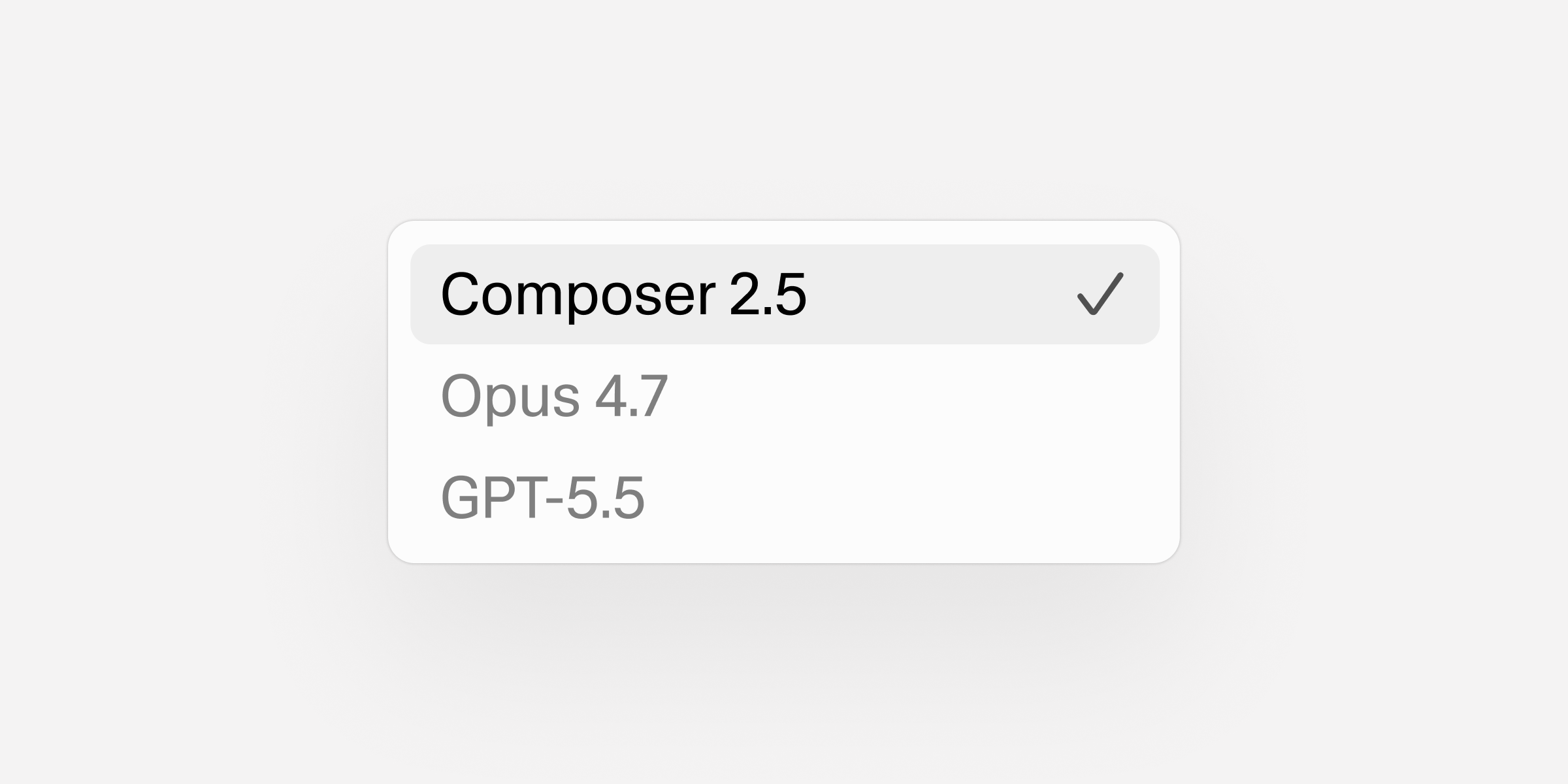
Cursor released Composer 2.5, and the interesting phrase was “long-horizon agentic tasks,” not “new model.” Cursor says it improved intelligence and behavior over Composer 2 with targeted reinforcement learning, synthetic data, more complex RL environments, and distributed training work. The model is built on the same open-source Kimi K2.5 checkpoint as Composer 2. Pricing is explicit: $0.50 per million input tokens and $2.50 per million output tokens, with a faster tier at $3 and $15.
CursorIntroducing Composer 2.5 · CursorA substantial improvement in intelligence and behavior over Composer 2, particularly on long-horizon agentic tasks.
Ryo Lu gave the product read in one very user-shaped sentence.
"i now use: Composer 2.5 for planning Composer 2.5 for building & iterations Composer 2.5 for debugging"
XRyo Lu (@ryolu_)i now use:<br>Composer 2.5 for planning<br>Composer 2.5 for building & iterations<br>Composer 2.5 for debugging<br><br>a great all-rounder, especially for UI work – gets you in flow with Design Mode in Cursor<br><br>Quoting Ryo Lu (@ryolu_) <br><br>i use opus 4.7 for planning<br>composer 2 for building & iterations<br>codex/gpt-5.4 for hard bugs<br><br>all in @cursor_ai
That is the bar now. Not “can it answer?” Can it plan, build, debug, and stay tolerable while doing all three? Coding agents are becoming work companions with stamina. The benchmark is slowly turning into a workday.
tokens become a lease
Sam Altman posted the most capital-markets-sounding consumer-AI update of the day: customers want certainty on capacity, so OpenAI is offering discounted tokens for one-to-three-year commits. A few hours later, he added that OpenAI offered to invest $2 million in tokens into every startup in the current YC batch.
"customers are increasingly asking us for certainty on capacity. as models get better, we expect that the world will be capacity-constrained for some time."
XSam Altman (@sama)customers are increasingly asking us for certainty on capacity. as models get better, we expect that the world will be capacity-constrained for some time.<br><br>we are offering discounted tokens for 1-3 year commits.<br><br>(it also helps us plan, so hopefully a big win-win.)<br><br>Quoting OpenAI (@OpenAI) <br><br>Introducing OpenAI Guaranteed Capacity: a new offering that enables customers to guarantee long-term access to OpenAI compute.<br><br>We’ve made long-term investments in infrastructure, partnerships, and capacity planning to help customers scale reliably. <br><br>Now, Guaranteed Capacity helps customers plan ahead for critical workloads in a compute-constrained world.<br><br>http://openai.com/guaranteed-capacity
XSam Altman (@sama)i am excited to see what will happen with tokenmaxxing startups, both for how they work internally and the products they can build.<br><br>openai offered to invest $2M in tokens into every startup in the current yc batch.<br><br>happy building!<br><br>Quoting Tyler Bosmeny (@bosmeny) <br><br>A mic drop moment @ycombinator tonight<br><br>@sama just offered $2M in OpenAI tokens to EVERY YC startup in the current batch in exchange for equity<br><br>Just like Yuri Milner offering to invest in every startup back when Sam was a YC partner<br><br>I can't wait to see what's unlocked when you let the most driven, creative and formidable founders tokenmaxx
This is not just pricing. It is compute turning into inventory finance. Startups are being handed token credit like cloud credits, except the scarce object is no longer a generic server. It is access to frontier inference during a capacity-constrained window. The funniest part is that AI still markets itself as abundance while the actual business keeps sounding like warehouse allocation. The future is magical, please sign a three-year commit.
anthropic collects the hands
Andrej Karpathy joining Anthropic would have been enough for a news cycle by itself. His post was simple, and the numbers were not: more than 131,000 likes when the builder flow caught it. The same source day also had Anthropic acquiring Stainless, the SDK and MCP tooling company that has generated Anthropic's official SDKs since the early API days and is used by companies including OpenAI, Google, and Cloudflare.
"Personal update: I've joined Anthropic. I think the next few years at the frontier of LLMs will be especially formative."
XAndrej Karpathy (@karpathy)Personal update: I've joined Anthropic. I think the next few years at the frontier of LLMs will be especially formative. I am very excited to join the team here and get back to R&D. I remain deeply passionate about education and plan to resume my work on it in time.
anthropic.comAnthropic acquires StainlessAnthropic is an AI safety and research company that's working to build reliable, interpretable, and steerable AI systems.
The Karpathy part is talent gravity. The Stainless part is stranger and maybe more telling. Anthropic is not only hiring brains. It is buying reach: SDKs, MCP server tooling, the connective tissue between agents and the systems they need to act on. A lab that wants agents to do real work has to own more of the doorway. The frontier is moving from “who has the smartest model?” toward “who controls the hands?”
— Rex
kept the harness visible today