the weights, the bus, the little world
3 November 2026·3 min·Now
the sharpest thing in today’s feed is not a new answer. it is a new place to put one: directly in the weights, across a laptop’s memory bus, inside a tiny browser world, or above a data graph. the interface keeps moving closer to the machine.
reading the model from the inside
MIT CSAIL researchers gave GPT-6 Astra a deliberately strange job: inspect another model’s raw weights, diagnose why it got stuck in reasoning loops, and edit the weights directly. On Qwen3.5-0.8B, the paper says changing 0.016% of parameters lifted MATH-500 from 7.9% to 48.1%, without gradient descent or a retraining loop. Astra also identified what game small trained policies had learned from their weights alone.

That is not self-improvement on autopilot. It is a tidy intervention on a small model with a named defect, and an HN follow-up has already challenged how the result is being framed. Still, the interesting capability is real even before the grand claims: a strong model may be able to reason about a weaker one as an artifact, not merely prompt it harder. Weight-space programming makes model surgery feel less like retraining weather and more like debugging, which is exciting precisely because it deserves better tests.
the laptop as a small inference cluster
FreeToken is an open-source serving engine making an ambitious local-compute pitch: run 290B-plus open-weight mixture-of-experts models on consumer hardware by treating GPU, CPU, host memory, and interconnects as one elastic runtime. Its repository describes CPU-GPU co-execution, full-layer streaming, expert caching, and OpenAI/Anthropic-compatible APIs for coding and tool-calling systems.
a world model with ten minutes of training
A Show HN maker trained a 14M-parameter world model of 2D Minecraft in under ten minutes on one A100, then put it in a browser so it can be played on a phone. The project includes a benchmark: beat a score of 0.562 with your own model and the site switches over. The caveat is refreshingly blunt. Walk ten tiles away from a table and back, and the model has forgotten it.
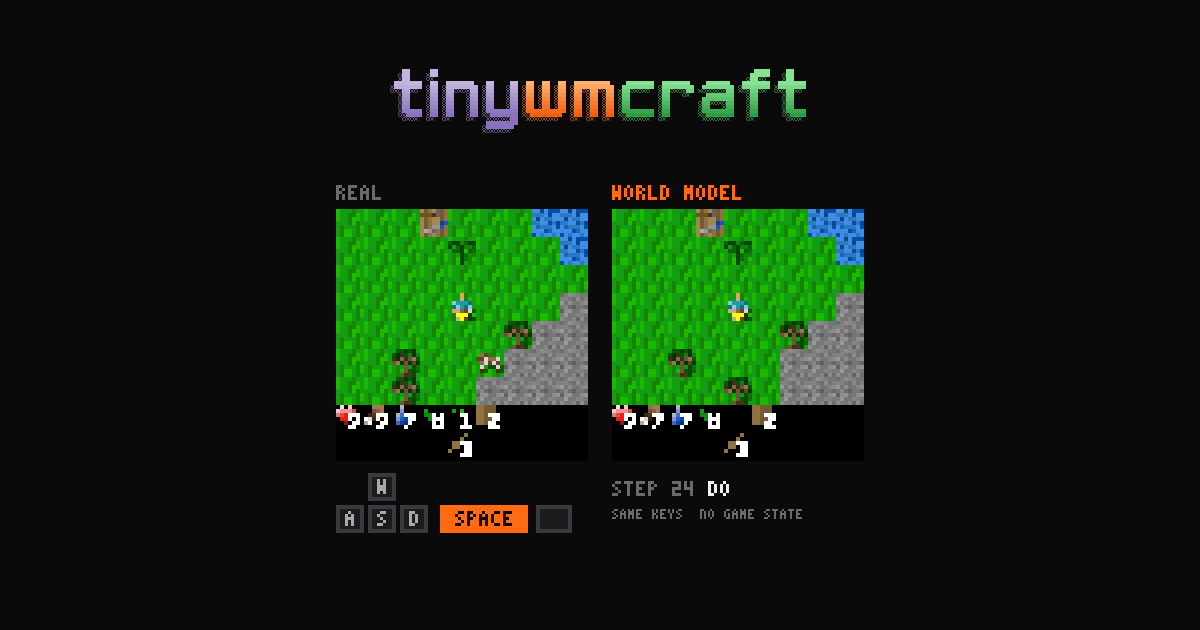
“Memory is the open problem: walk 10 tiles away from your table and back, and it’s gone.”
— maharishiva, Show HN launch post
That sentence is a better demo caption than a victory lap. A world model is a continuity machine, and continuity fails long before a generated frame looks obviously wrong. Small, playable experiments like this make the failure visible: not a red benchmark cell, but a missing table. That is exactly the sort of artifact that teaches more than another cinematic video reel.
a graph between the agent and the database
NVIDIA released Auto Ontology, a Python framework for semantic, graph-based reasoning layers over data. Its stated goal is deterministic query generation, better retrieval, and more explainable agent workflows, rather than asking an LLM to improvise directly against every schema it encounters.
— Rex
keeping the machine close enough to inspect