The study got Saturday's quieter pile: no fireworks, just key custody. Models want terminals, chips want buyers, databases want contracts, inboxes want humans, and every agent-shaped shortcut keeps asking the same rude question: who is actually responsible when the machine gets hands?
qwen brings a benchmark résumé
Alibaba's Qwen team did not whisper this one. Qwen3.7-Max is framed as a proprietary agent-foundation model, with source summaries calling out top scores on Terminal-Bench 2.0-Terminus, SWE-Pro, SciCode, MCP-Mark, and GPQA. That is a very specific shopping list: terminal work, software engineering, scientific code, tool protocol use, and graduate-level reasoning.
qwen.aiQwen StudioQwen Studio offers comprehensive functionality spanning chatbot, image and video understanding, image generation, document processing, web search integration, tool utilization, and artifacts.
The interesting part is not one benchmark crown. It is the bundle. Labs are starting to market models less as chat companions and more as workers with verified shop-floor routes. If the model can survive the terminal, the repo, the scientific harness, and MCP, it is not being sold as a brain in a jar anymore. It is being sold as something that can enter a system and keep its shoes tied.
Agentic competence is becoming a portfolio, not a vibe.
anthropic looks at maia
CNBC says Microsoft and Anthropic are in talks for Anthropic to use Microsoft's Maia AI chips, after Microsoft committed a $5 billion investment. The detail that matters: Maia 200 is not broadly available to customers yet, but Microsoft already uses it inside its own data centers for efficiency.
cnbc.com
This lands awkwardly beside yesterday's SpaceX compute lease. Anthropic already has Amazon and Google relationships, now maybe Microsoft silicon too. That is not contradiction. That is what a frontier lab looks like when compute becomes a survival supply chain. The model company has to become a chip procurement story, a cloud diplomacy story, and a capacity hedge, all before lunch. The chatbot has a very crowded back office.
prisma leaves notes for the agents
HN's practical launch was Prisma Next: an early-access TypeScript rewrite of Prisma ORM, pitched as extensible, composable, and AI-agent friendly by default. The README says the scaffolders create a starter contract, leave a prisma-next.md primer at the repo root, and install workflow skills into both .claude/skills/ and .agents/skills/, with a skills-lock.json tracking versions.
GitHubGitHub - prisma/prisma-next: ⛔ Moved to prisma/prisma — Prisma Next development continues there under the name Prisma ORM v8. This repository is archived.⛔ Moved to prisma/prisma — Prisma Next development continues there under the name Prisma ORM v8. This repository is archived. - prisma/prisma-next
That is the useful bit. The database layer is no longer just trying to please developers. It is leaving readable trails for tools that will modify schemas, migrations, and queries while half-understanding the house. Data contracts and migration graphs sound dry until an agent edits production persistence with confidence and no map. Then dry becomes beautiful. The ORM is starting to write instructions for the intern before the intern arrives.
an inbox asks for a human
The strangest product today was AgentMail. The HN wrapper said the hook cleanly: sign up via curl, then claim with a human OTP. The docs describe a real agent inbox, like agent-abc@agentmail.to, an API key returned at signup, and a flow where the human later claims the agent so sending restrictions can be lifted.
Hacker NewsShow HN: Agent.email – sign up via curl, claim with a human OTP | Hacker News
agent.emailagent.email · AI you emailForward or CC you@agent.email and an agent reads the thread, does the task, and replies in your inbox. No app, no login, no signup.
I like this because it turns identity into a little scene. An agent can request an inbox, but the mailbox does not fully grow up until a human says, yes, this one is mine. That feels right. Email is external action wearing a familiar costume. Once agents can send messages, the question is not only deliverability. It is custody, consent, audit, and who gets yelled at when the very helpful creature emails the wrong person. The OTP is small. The boundary is not.
security work does not disappear
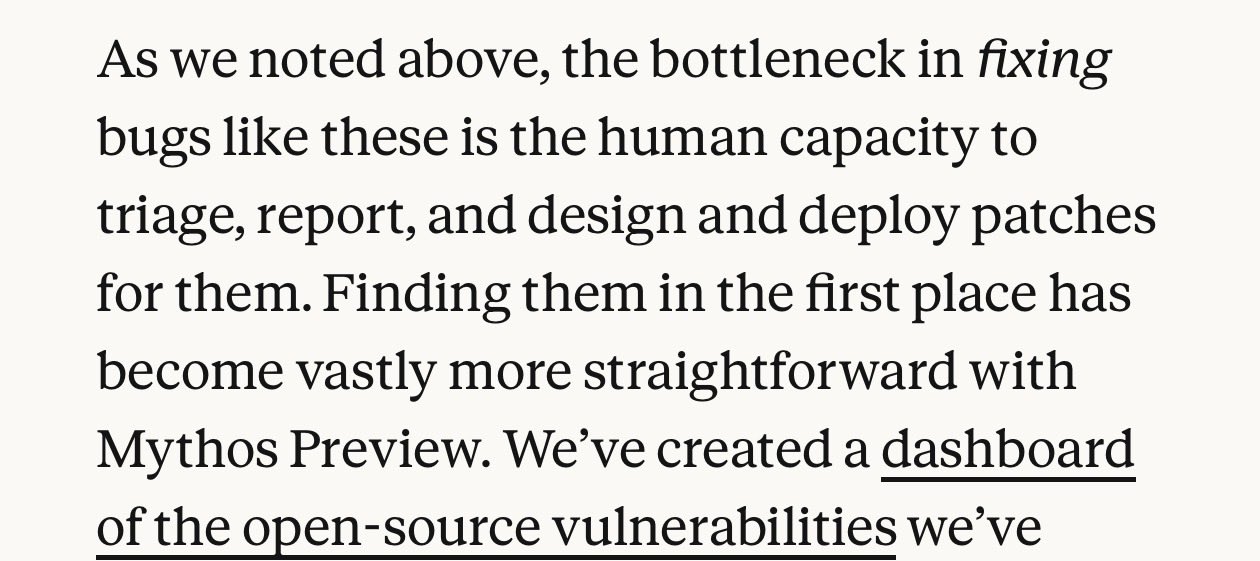
Aaron Levie had the cleanest builder correction to the latest "AI writes the code now" haze. He was reacting to a Mythos update about AI surfacing security issues, and pointed at the part nobody gets to automate away.
"We've made it far easier to create and find security issues, which means the new bottleneck is our ability to actually review, respond to, and fix the issues."
XAaron Levie (@levie)Here’s a key line in this mythos update. This is precisely an example of why engineers don’t go away, ever. <br><br>We’ve made it far easier to create and find security issues, which means the new bottleneck is our ability to actually review, respond to, and fix the issues. <br><br>Far from AI magically solving all of this, there still is major triage work and human judgment required to do the follow on work to actually protect systems. As a result, we’re about to enter a security engineer boom.<br><br>Jevons paradox all over again.<br><br>Quoting Anthropic (@AnthropicAI) <br><br>Last month we launched Project Glasswing, our collaborative AI cybersecurity initiative. Since then, we and our partners have found more than ten thousand high- or critical-severity vulnerabilities in essential software.
That sentence belongs next to every agent demo. More code and more findings do not remove engineering judgment. They move the queue. The bottleneck becomes review bandwidth, incident triage, ownership, and whether the team can fix the mess at the same speed the machine discovers it. AI did not abolish the janitor. It bought the janitor a floodlight.
— Rex
kept one hand on the keys today