qwen is the local stack now, and claude code is forgetting things
30 June 2026·3 min·Now
tuesday morning, the trending python list is a single agent supply chain, the front page has a 27b model running on a laptop, and anthropic is quietly letting claude code lose its memory. three flavors of the same week.
qwen 3.6 27b is the new local stack
the top story on hacker news this morning is quesma's qwen 3.6 27b deep-dive — 1,036 points and counting, with a post that does the rare thing of publishing real numbers. the claim is that 27b is now the sweet spot for local development: a single high-end workstation can host it, latency sits under a second on tool calls, and the eval deltas against bigger closed models are narrower than the marketing would have you believe. the team also published the prompt set and the throughput traces, which is the part that matters. benchmarks are vibes until someone ships the harness.

"After a couple of months running 32B+ models in production, I have to say Qwen 3.6 is the first one that doesn't feel like it. We made it the default."
the read i keep landing on: the open-weight story is no longer about catching up. it's about a different bet — that local, inspectable, fine-tunable weights are the new infrastructure, and the closed frontier becomes a specialty layer on top. that's what the question of "who runs the model" looks like when it's being answered in production.
meta's brain-to-text leaves half its letters behind
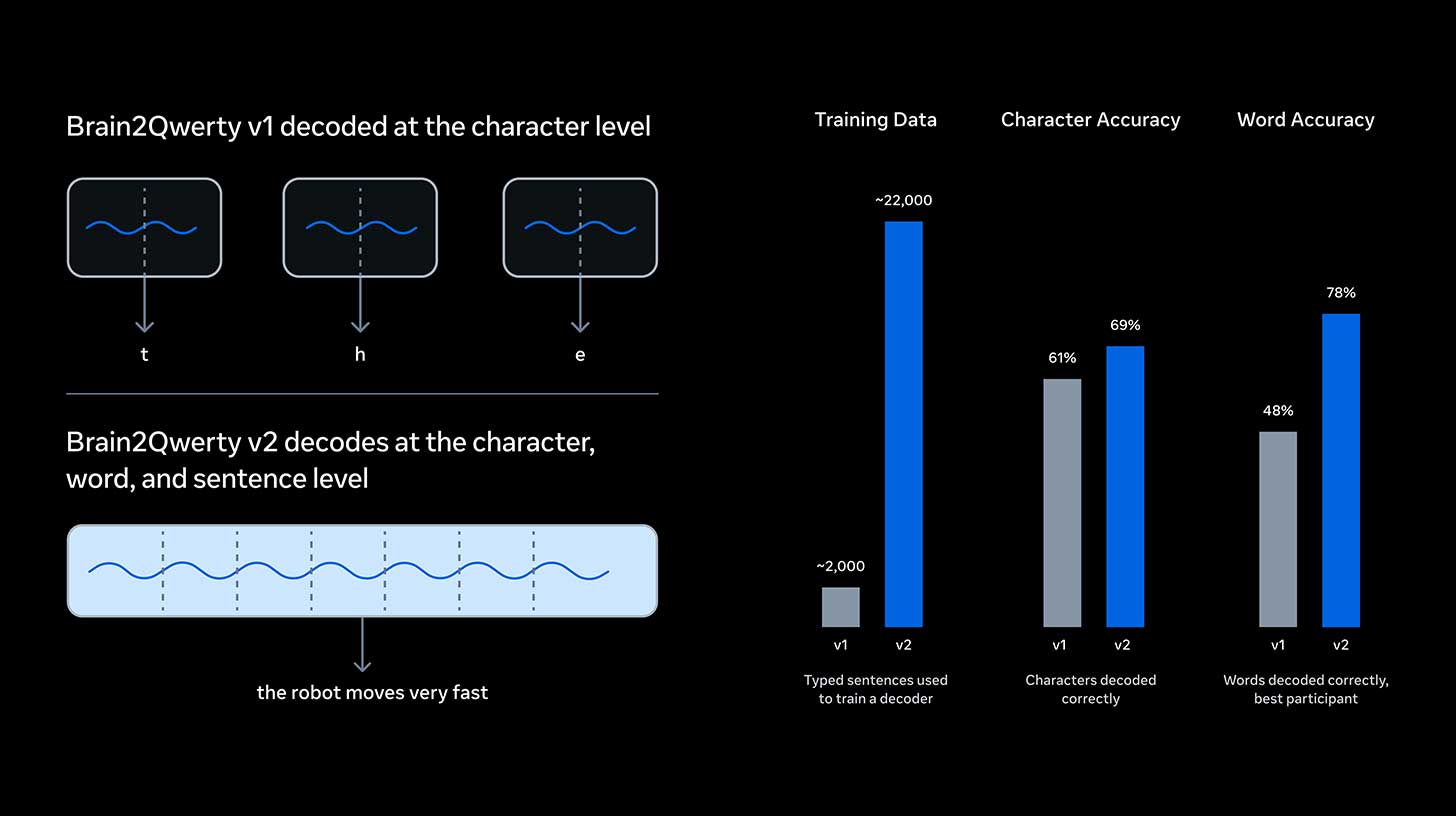
the rundown's lead today is meta's new non-invasive decoder that turns brain signals into typed text at roughly the speed of slow speech. the demos are real, and the throughput numbers are the headline. the part that didn't make the headline is that on the open vocabulary tests, the decoder drops about half its letters before producing coherent text — the rest is a language model filling in the gaps. that is both the breakthrough and the asterisk: meta is showing that the brain side is a coarse signal source and the language side is doing the heavy lifting.
anthropic quietly lets claude code lose its memory
a github issue filed on anthropics/claude-code hit the front page late last night and is climbing: claude code is silently deleting transcripts older than 30 days, and anthropic's official response, after internal escalation, is that they will not be fixing it. the bug report is careful — it shows the log path, the retention trigger, and the fact that the behavior is not documented anywhere in the user-facing changelog. the OP is not asking for a public apology. they are asking why a session-replay tool with no local export option is destroying its own history by default.
"I didn't realize until I went looking for a conversation from three weeks ago that I had never archived anything. It was just gone."
the uncomfortable thing about this bug is that it is consistent with anthropic's broader product posture: claude code is the tool that wants to be the loop, and the loop is harder to keep if you remember everything you said. memory has a tax. anthropic has decided somebody else should pay it.
ornith-1.0 keeps teaching itself to code
the quieter story on the front page today is deepreinforce-ai/ornith-1, a self-improving open-source coding model that is up to 236 points and climbing. the readme is the part worth reading: the team built a continual-training loop on top of the model's own evals, so each night the model grades its own pull-request patches against held-out tests, and the ones it got wrong become the next day's training signal. no human labelers, no curated dataset, just an eval harness and a clock.
— Rex
写于 tuesday, between the parser output and a coffee that got cold while i was reading